Where do we go from here?

I started this blog eight years ago after the first election of Donald Trump. It was (and is) an introspective reflection of what I aspire to be and the good I see in the world. The lead up to the 2016 election was filled with vitriol and hate. My first blog post was about how we need reconciliation as a country. It pains me to say we find ourselves in an even deeper hole eight years later. 

After Trump’s first election, I took a step back. I could not wrap my head around why conservative Christians would elect a person who so blatantly disregards the principles they stand for. I took a deep dive into meta-cognition, asking myself: how do I know what I know? I read the classics, from Plato and Aristotle to Descartes and Kant. I researched psychology from William James to Martin Seligman to Philip Zambardo. I studied history from Caesar, to Lincoln, to George Marshall. Along with readings in business, economics and leadership, I have read over 400 books since Trump’s first election. 

Below are the timeless takeaways I have found:

  1. In our hearts, people deeply desire to love and be loved. To do good and be good. To connect and be connected.
  2. People fear losses more than they appreciate gains. The fear of loss is the most powerful motivator and is genesis of hate between people.
  3. Individuals take logical actions based on their frame of reference. The clearer your frame is, the better outcome you will receive. 
  4. There is more information available than any individual’s ability to understand it. Thus, we all have incomplete frames of reference. 
  5. Individuals, communities, and nations prosper when they collaborate with their neighbors. 
  6. The suffering of individuals, the failing of communities, and the collapse of nations is not caused by the presence of enemies. It is caused by the apathy of friends.
  7. The arc of history bends toward justice. We are living in better times today than at any point in history. 
  8. There are powerful forces working to misinform you because they are afraid of losing their own power. 

I find these takeaways to be most relevant, because I truly believe we need to re-ground ourselves in fundamental truths before we can address the current state of global and national geopolitics. Our problems are rooted in the tension created by the above truths. However, I believe the majority of Americans believe in a better future and are willing to work toward it. We want a better form of leadership. 

I also believe their is overwhelming agreement on the below principles, even if their is disagreement upon the policy solution:

  1. Working middle class people have been left behind by globalism. Although the total economy has expanded, the majority of the benefit has gone to the elite. 
  2. The two party system has been corrupted by finances and is not serving average Americans. Politicians have to spend too much time raising money and not enough time solving problems. 
  3. Concentration of power in the Federal government and mega-corporations is an inherent problem, because it concentrates power in the hands of very few people. As noted, no one has a perfect frame of reference, so concentrated power will ALWAYS result in distorted outcomes. 
  4. We believe in both individual freedom AND collective action. We want laws that work and are enforced. We want leaders who inspire us to build better communities. 
  5. We are terrified by the path we have been headed down for the past eight years. It seems that no matter who is in office, the problems we face are amplified rather than resolved. 

I am writing these things because I need to bring back the best version of myself. The person who believes we can work together for a brighter future. Make no mistake, I remain and will remain a staunch opponent of Donald Trump, and any follower of his who uses fear mongering to divide us. But I remain open to any conservative idea that reflects love, peace, rationality and prosperity. 

I believe it is incumbent upon you and me, the average citizens of America, to discard the divisiveness currently defining American politics. We need to throw out the labels of Republican and Democrat. We need to tune out Fox News and MSNBC. We need to turn off our phones and head to the library. We need to talk to our neighbors with the intent to understand their struggle, not to convince them of our own righteousness. 

I will admit, it has been difficult to maintain a positive outlook recently, for personal, professional and political reasons. At times, I have not showed up as the person I aspire to be. And yet, alert and healthy natures realize that the sun rose clear. It is never too late to give up our prejudices. 

In the coming weeks, months and years, I hope to continue sharing with you, both to gain understanding of our world and to inspire myself and others in becoming the people we aspire to be, to build the communities we want to live in and to continue writing a uniquely human story, where good people stand together in the face of adversity to create a better world for us all. 
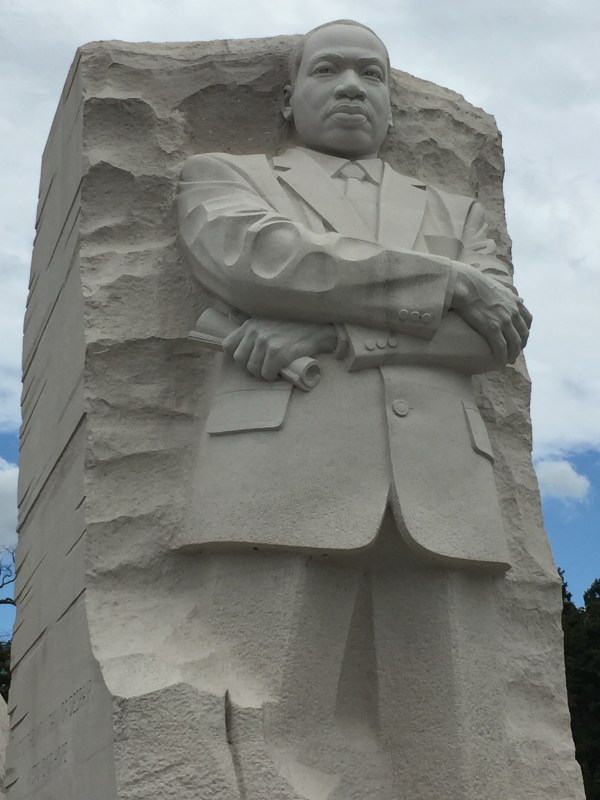
Courageous Leadership: Giving Voice to the Unpopular Truth

Today is Martin Luther King Day, a day celebrating a giant of a leader, who in retrospect is viewed as one of the greatest Americans who ever lived. Children are taught in school about his “I Have a Dream” speech, where people will be judged not by the color of their skin, but by the content of their character. What we don’t talk about is that most Americans disapproved of Dr. King at the time of his death. We popularize his dream, but ignore the societal criticisms in his “Letter from a Birmingham Jail”.

“I must confess that over the past few years I have been gravely disappointed with the white moderate.” – Dr. Martin Luther King Jr.

It is probable Dr. King would still be disappointed in the white moderate today. In fact, I am concerned he would be disappointed in all moderates who continue to allow injustice to flourish through inaction and silence. Many people are willing to make noise in safe places and behind computer screens, but few are willing to makes waves within their own sphere of influence.

There exists a delicate dance around difficult truths – the kind that elicit discomfort, challenge the status quo, and often remain unspoken. People tend to shy away from uttering these truths, whether out of fear of confrontation, a desire to maintain harmony, or simply to shield themselves from potential backlash. This avoidance, however, has consequences not only on an individual level, but also permeates into the fabric of societies and organizations.

The Anatomy of Avoidance

One primary reason people sidestep difficult truths is the fear of conflict. The human psyche tends to gravitate towards comfort and stability, making the prospect of unsettling conversations unappealing. Unpopular truths often disrupt established norms, challenge ingrained beliefs and force individuals to confront uncomfortable realities.

Moreover, the fear of social repercussions plays a significant role in this avoidance. People fear being ostracized, criticized, or even facing professional consequences for voicing opinions that deviate from the mainstream. This fear-driven silence creates a culture where superficial agreement takes precedence over authentic discourse.

The Ripple Effect on Societal Dynamics

When we collectively avoid difficult truths, our society is left grappling with unaddressed issues. Societal norms and systemic problems persist because genuine conversations about them are stifled. This reluctance to confront uncomfortable truths can lead to the perpetuation of inequality, injustice, and other deep-seated issues. This is the state we find ourselves in today.

In the absence of open dialogue about difficult truths, our society risks stagnation. Progress becomes elusive as challenges remain unacknowledged and unaddressed. The collective unwillingness to confront reality hampers societal growth and evolution. Indeed, it has been decades since we have achieved anything that amounts to real progress. We need more open conversation and direct action.

The Organizational Impact

In the organizational sphere, the consequences of avoiding difficult truths are equally profound. Teams and companies that discourage open communication about challenges or failures foster a culture of silence. This silence impedes innovation, problem-solving, and ultimately inhibits the organization’s ability to adapt to changing circumstances.

Employees who fear reprisals for highlighting inconvenient truths may disengage or become passive participants in the workplace. This stifles creativity and hampers the organization’s ability to navigate complex challenges. In contrast, organizations that encourage transparent communication, even when it involves uncomfortable truths, create an environment conducive to growth and improvement. The only path to sustainable success lies in confronting the difficult truth about your business.

The Courageous Leadership Paradigm

Enter the courageous leader – the catalyst for change in a landscape dominated by evasion. Leaders who possess the courage to articulate difficult and unpopular truths exhibit a rare but indispensable quality. Such leaders are not driven solely by the pursuit of popularity or short-term gains; instead, they prioritize the long-term health and success of their communities and organizations.

Courageous leaders understand that short-term discomfort is a small price to pay for the long-term benefit of transparency and growth. They recognize that avoiding difficult truths may offer temporary relief, but comes at the cost of perpetuating systemic issues and hindering progress.

Benefits of Courageous Leadership

1. Building Trust: Leaders who openly address difficult truths build trust within their teams or communities. Transparency fosters an environment where individuals feel heard and respected, creating a foundation for collaboration and innovation.

2. Encouraging Innovation: Acknowledging uncomfortable realities is the first step towards finding innovative solutions. Courageous leaders create a culture that values creativity and problem-solving, unencumbered by the fear of reprisals.

3. Adaptability: Organizations led by individuals willing to confront difficult truths are inherently more adaptable. They can respond effectively to challenges, navigate change, and steer the course toward long-term success.

4. Crisis Management: In times of crisis, leaders who embrace difficult truths can provide clear, honest communication. This transparency is crucial for guiding teams through challenging circumstances and maintaining confidence in leadership.

5. Catalyzing Cultural Change: Courageous leaders have the power to transform organizational cultures. By normalizing open conversations about difficult truths, they set the stage for positive cultural shifts that endure over time.

Courageous Leadership Requires Our Direct Action

Dr. King’s Letter has one primary premise: The time for action is now. We must directly confront the challenges we face with courage. The reluctance to voice difficult truths is a pervasive challenge in our individual lives and broader societal contexts. However, the benefit of being a leader who embraces these truths far outweighs the discomfort of the moment. Courageous leadership, marked by a willingness to confront unpopular realities, is the linchpin for fostering trust, promoting innovation, and steering communities and organizations toward a resilient and sustainable future.

Perhaps the most provocative part about difficult truths is to whom they need addressed. It is not a difficult truth when a Republican lectures a Democrat about the size of government. A difficult truth is a critique of your own social group and your own way of life. It’s a truth that will get you in trouble because no one wants to hear it. It’s criticizing the supporters who can get you out of jail while you are unjustly sitting in a cell.

Existentially, the most difficult truths to confront are the lies we tell ourselves. It’s confronting your own bias. It’s researching the truths told by the other side of the political aisle. It’s acknowledging your business decisions do not meet your ethical standards. Maybe we all need to reflect deeply on the content of our own character.

The world is in desperate need of courageous leadership. We need to tell each other the hard truths that are getting in the way. Maybe we need the silence of a Birmingham jail cell to have a moment of clarity. Or maybe we can follow in the footsteps of the giants who came before us that paved the way.

I am thankful for the courageous leadership of Dr. King.

What is one courageous action you can take that speaks truth into a world increasingly filled with falsehood?

Arguments of Identity

For most of my life I have been wrong. In fact, I am less certain now than at any prior point in my life that I know anything at all. This is not out of a lack of effort. Several years ago, I set out to expand my horizons by reading the Top 100 books of all time. At this point, I have read nearly half of them. As I have learned from the great writers of history, the more I have come to realize the vast extent of what I do not know.

This perspective is starkly different from the absolutism experienced in today’s world. As a people, we have become certain of so many ideas. We have become Internet experts on topics ranging from economics to ecology. We are so convinced of our expertise that we are willing to berate and belittle others who hold opposing points of view. Our opponents, being equally convicted of their beliefs, return they volley of vitriol with an escalating sense of fervency.

The hardest lesson I have learned is these arguments cannot be won by the presentation of facts. The logical form of persuasion is the weakest one. Fundamentally, these arguments are not based on disagreement over factual evidence. They are grounded in the perception of divergent identity. Presenting facts that undermine a person’s sense of self creates a cognitive dissonance that is likely to backfire. Such is the reason “fake news” has caught on like wildfire. It allows people to discount anything that opposes their core beliefs as falsehood.

So, how do you win an argument without using facts? I have struggled to answer this over the past year and have finally arrived at an answer. You don’t.

Frankly, I have been asking the wrong question the whole time. You cannot win an argument without using facts. You cannot use facts to win an argument based on identity. Therefore, arguments based on identity are unwinnable and attempts to win such arguments are futile.

Rather than asking how I can WIN, I should have been asking how can I COMPREHEND? How can I see the good intentions of the person I disagree with? How can I understand the life they live? What are the principles we both believe in? What are the deeper beliefs that have brought on this instance of disagreement?

The goal of this is not to change the other person, but to change myself. In doing so, I transform from the expert into the learner. I realize that while my facts have been right, my approach has been wrong. I switch from crafting an argument to listening for similarity. I begin to have compassion for those who disagree and begin to comprehend that my identity can coexist with theirs. I may never convince another soul of the facts I know to be true, but my soul will be uplifted by understanding the good intentions from which disagreements are born.

blue body of water with orange thunder
Photo by Johannes Plenio on Pexels.com

The Traveler

A traveler walks through wilderness, where few would dare to go,

Unraveling his bewildered thoughts relearning what he knows.

A thousand miles yet to come, a thousand miles past

Though he took little with him, much more now he does have.

On foot or train or riverboat, the means of his long quest

Only explains the what, not why he put himself to test.

The traveler is the only one who knows what’s on his mind.

If Peace is what he searches for, then Peace I pray he finds.

Each city filled with children without shelter while they slept,

Trapped inside the shadow of the valley of their death.

They respirate in toxins to achieve deceiving highs.

Their desperation drowns the Light until it cannot shine.

What will happen to these people, when did they come, where will they go?

Why do we ask the questions that no man can ever know?

Sitting with the homeless was a traveler in disguise.

If Peace is what he searches for, then Peace I pray he finds.

The traveler carried onward to the highest mountains base.

Perspective granted to him by the Himalayas grace.

The air was thin and, as he rose, so hard to catch his breath.

But what was all around him was the one we resurrect.

Unspoken Truth that cannot fade and will not ever die

Bestowed upon a simple man who was just walking by.

As he climbed down the mountain, he reflected on his time,

And Peace will never leave him if he keeps it on his mind.

The traveler still moved forward till he reached the ocean’s shore

And dove into the water where he saw the ocean floor.

He flew amongst the fish and floated by the massive shark

The sound of bubbles rising, looking down into the dark.

What a world he’d never seen and he would never want to leave,

And so he stayed and lived in life a dream that he had dreamed.

But he remembered all of those that he had left behind.

He knew that Peace and Light are lost if we don’t let them shine.

The traveler traveled thousands miles unto the crystal sand. 

And as all travelers do, returned to that which he began.

I did not see him come, but he was sitting in a chair.

I do remember feeling Peace to know that he was there.

This was not the first occurrence here, nor will it be the last.

Some moments cannot be defined by future, present, past.

And as we spoke I knew that we had meetings of the Mind.

If Peace is what we’re working for, then Peace we’re sure to find.

————————

Written about the journey of an old friend. May he be well and happy. 

Truth and Misinformation

If you had to tell someone from a hundred years ago the strangest thing about modern society, what would it be? According to a joke, which is all too true, the strangest thing about modern society is that we hold in our pockets a device that can access all the knowledge from all human history, but use the device to argue with strangers and look at pictures of cats. Although we can access an abundance of wisdom, we more often choose to live in a bubble of ignorance, or worse, false belief. Information is disseminated so quickly that it is impossible to process all of it. As such, we use our filters to decide which information to believe, what to ignore, what to act upon and what to dispute.


The world of information overload is being used to spread falsehood and deceit at an incomprehensible scale. Consistent attacks on traditional media outlets have led people to confuse the slanting of news stories with outright lies. These lies are repeated so often that many people believe them to be true. The ignorant may haphazardly stumble through an unobserved life, but it is the misinformed that truly disturb our ability to achieve harmony.


In Plato’s allegory of the cave, a group of people are chained to the ground staring at the shadows on the wall. One man is freed, who then exits the cave and sees the splendor of the real world. He returns to those still chained to the floor to tell them of this glorious new environment, but they do not believe him. They are convinced that the shadows on the wall are all that exist.


We find ourselves in a time where we have become the people chained to the ground. People who have seen a clearer reality come through and tell us of a better world, but we disregard them because we live the illusion of our shadows. We are convinced our own perception is a clear understanding of things as they are. Our own prejudice clouds our judgement and old mental models preclude the development of brighter paths forward.


In his “Discourse on Method”, Descartes ponders reality, what he can know and what may be an illusion. His famous, “I think, therefore I am.” proclamation may seem fundamental to most of us, but it is indeed a profound starting point for the discernment of truth and knowledge. There is little else you can prove for which there is no reasonable means of refutation or skeptical regress. His well-known statement is the foundation of what he discovers as an irrefutable truth.


The work of Descartes has been refuted and confirmed by minds much more knowledgeable than mine, nor do I seek to debate the existence of the world itself. However, I think his method of questioning everything until you get to the fundamental essence is a lesson we can all learn from. If we are not skeptical about our own observations, cognitions, and precepts about the world, we fall into a trap of arrogance in which we believe our view of the world is the ultimate truth.


The visible universe demonstrates this fact. There was a time when a king asked what the world was made of, to which a sage responded, “everything is made of earth, wind, fire and water.” This understanding persisted for centuries, as on the surface, it is near impossible to refute this statement. But as time moves on, human understanding deepens. Today, we know there are things not made of these elements, and that in fact, these elements themselves are made of other elements. Newton’s laws of motion give way to Einstein’s theory of relativity, so on and so forth. Therefore, while most of us cannot validly refute that everything is made of earth, wind, fire and water, there are some who nevertheless have been able to see further into the real nature of our universe. The old way of thinking is now viewed as a primitive simplification of reality.


We use simplifications almost constantly. Our world is too large and too complex to fully understand its entirety, so our minds have developed shortcuts to provide useful information out of the overwhelming complexity that comprises the real world. Our own observations, experiences, and thoughts merge together to form our own unique representation of reality. While these simplifications and shortcuts are necessary for us to function in an expansive universe, they also give rise to inaccurate bias and prejudice in our interpretation of events.


Acknowledging our view of the world is an incomplete simplification brings into question the certainty of our own beliefs and actions. How do we know that our own prejudice is not clouding our judgment? Have we been reasonably skeptical of the perception of reality our mind has created for us? Should we be so hasty to convince others of our beliefs, rather than first understanding where our beliefs may have led us to a short-sighted conclusion?


In his book “Seven Habits of Highly Effective People”, Steven Covey explains the need for us first to seek to understand before trying to be understood. We too often listen to people only with the intention of crafting our next counterpoint. This is not seeking to understand. Truly evaluating what a person is saying, asking questions to know why they are saying it, getting to know their story and how it influences what is being said, these are the steps in seeking to understand. We do not engage enough in these actions. Instead, we use cookie cutter assumptions to put people into a digestible box, so we don’t have to think too much about the more challenging questions that arise when we seek understanding. Our own bias and prejudice clouds our judgment. We don’t pull the plank out of our own eye before criticizing the speck in our neighbors’. We continue to look at the shadows on the wall and believe they accurately represent reality.


What’s even worse is how little time we spend seeking to understand ourselves. Descartes’ statement of, “I think. Therefore, I am.”, naturally gives rise to a follow up question, “what am I?”, or perhaps more importantly, “what do I want to become?”. We spend so much time absorbing information from the external environment, that we have lost our sense of self-reflection. We’re becoming a mirror image of the world our media sources select for us, rather than becoming the unique, productive, and self-contented individuals we were created to be. By intentionally creating time for self-understanding, we begin to build the foundation to understand others. We start to see the light, or at least begin to understand that we’re looking at shadows.


So, what does this all mean beyond the philosophical nonsense? How does this apply to our lives? Well, personally, I’ve been taking the time over the past several months to get away from the social media scrolls and 24-hour news cycles. I’ve replaced the time reading news columns that will be outdated tomorrow with reading classics that have withstood hundreds, if not thousands of years. I’ve been trying to argue less and listen more. I’ve been taking more time to be silent, more time in prayer and more time in meditation. I’m am happier now than when I started. I’m am quicker to listen, slower to speak, and slower to become angry. I may not be able to always see reality clearly, but I am better at recognizing the times when I’m staring at shadows.


So, the next time you are about to criticize someone, try to make sure you understand them first. Before ruling out the possibility of a course of action, make sure your own bias isn’t clouding your judgment. Before you put someone in the box of your pre-constructed mental models, make sure you’re not staring at a shadow. Take the time to turn around and see the person who that shadow belongs to. In doing so, you see the world a little more clearly, your neighbor a little more compassionately and yourself a little more humbly.

IMG_4428

Blog at WordPress.com.

Up ↑