I have always loved the Fourth of July.
It carries fewer rigid traditions than Thanksgiving, and none of the frantic end-of-year pressure of Christmas. It arrives in the warmth of summer, inviting us outside—to soak up the sun, fire up the grill, and linger long into the evening. As a kid, it meant fireworks. I still remember a friend who brought back something far more powerful than the parking-lot tent stuff: M-80s, the kind that have been banned under federal law since the 1960s because they’re classified as illegal explosives. We set them off in a drainage tunnel and walked away half deaf for the rest of the day—equal parts reckless and unforgettable.
But beyond the sunshine and questionable judgment, the Fourth of July has always represented something deeper to me: the best of the American idea. A nation founded on a creed that all are created equal, endowed with inalienable rights to life, liberty, and the pursuit of happiness. It is a day worthy of celebration—not because those words were ever fully true, but because they named an aspiration we have been struggling toward ever since.
Juneteenth reminds us of that struggle.
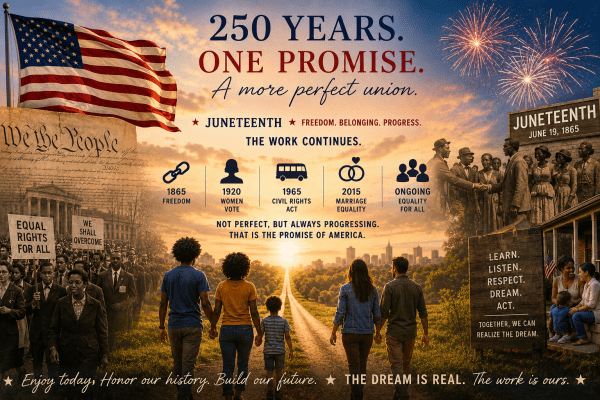
On June 19, 1865, Union troops reached Galveston, Texas, and announced that the roughly 250,000 enslaved people there were free—more than two years after the Emancipation Proclamation had already declared it so. Texas was the last Confederate state to be liberated. It isn’t quite the literal finish line: slavery in the United States wasn’t fully and legally abolished everywhere until the 13th Amendment was ratified that December, nearly six months later, closing the loophole that had let bondage persist a while longer in border states that never seceded. Legal freedom arrived late, in stages, and equality later still.
As the dust of the Civil War settled, the women who helped stitch together a wounded nation had no right to vote. Suffragists labored for another half century before the 19th Amendment finally recognized their voices at the ballot box in 1920.
Then came the deepening shadow of Jim Crow. The “separate but equal” doctrine, handed down by the Supreme Court in Plessy v. Ferguson in 1896, was never equal. It took until the Civil Rights Act of 1964—and the Voting Rights Act the year after—before race could no longer serve as lawful cover for discrimination in employment, public accommodations, and the ballot box.
Even then, freedom remained incomplete. Marriage, under the law, is a civil contract between two people. To deny that contract based on gender is simply another form of exclusion. It took another half century—until the Supreme Court’s 2015 ruling in Obergefell v. Hodges—before that equality was finally recognized nationwide.
And still today, we debate the rights of neighbors whose immigration paperwork is not in proper order—often forgetting that many of our own ancestors arrived on these shores with nothing but hope, faith, and a restless belief that something better was possible.
So I celebrate America’s 250th anniversary, not because our nation is without fault, but because it has shown, again and again, a capacity to confront its failures and move, however imperfectly, toward a more perfect union. Progress has never been automatic. It has always required listening, learning, and the courage to widen the circle of belonging.
I celebrate Juneteenth as well—not as a rejection of our founding ideals, but as a testament to them. Not to erase the words of imperfect people, but to insist that those words matter enough to be lived out fully. History’s greatest danger is not imperfection; it is the refusal to learn.
So I hope you take time to reflect this summer. I hope you enjoy the sunshine, the barbecue, and the fireworks—legal ones, ideally. And I hope you resolve to do the work—quiet or loud, small or bold—required to move us closer to the American dream. That dream still lies down the road, unfinished and demanding, and it will only ever be realized if we choose, together, to keep walking toward it.


