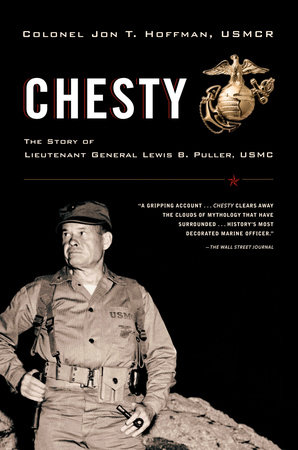
Some leaders in history are greater than fiction. Lieutenant General Lewis “Chesty” Puller is one of those examples. Widely considered the greatest U.S. Marine in history, Chesty’s career spanned four decades over which he accumulated five Navy Crosses. His life is biographied by Colonel Jon Hoffman in the work “Chesty: the story of Lieutenant General Lewis B. Puller”.
On first appearance, Chesty was the “Marine’s Marine”. A gruff voiced, profane warfighter who led from the front. He frequently determined how much courage a leader had by the casualty counts, and boasted that his officers had higher casualty ratios than his enlisted men. His Virginian ancestry gave him a love of Confederate tales and both he and those around him had a tendency to aggrandize the stories of his own careers as he progressed in age. Nevertheless, the historical records of his leadership under fire need no embellishment. Winning skirmishes in Haiti and Nicaragua in his younger years, then on to the legendary battles of Guadalcanal in World War II and the Chosin Reservoir in Korea, Chesty’s reputation was well deserved.
But his legendary leadership was more than a blood and guts desire for military conquest and glory. Chesty had exemplary conduct of how to lead his troops, on and off the battlefield. He was known for treating everyone with the same amount of respect, from the lowest enlisted man to the commanding general. He had unwritten rules for the officers under his command, requiring them to eat last in the chow line and ensuring they were ready to perform any task they asked their men to. He was a superb trainer, and on multiple occasions led the training elements that prepared Marines for the future battles the country would face. Beneath the image Chesty displayed to the world was a man who cared deeply about the people around him and who held everyone accountable for their actions, particularly those in authority.
Chesty’s example reminds me that leadership is a complex task. To lead myself and others effectively, I must look the part of the role, but also be present with the people I lead. I have to set high expectations and then show my team how to accomplish the mission. I have to work beside them through their efforts to accomplish our collective goals. Moreover, I need to set increasingly higher levels of achievement and accountability for my senior team members, as they are responsible for assisting me in creating a culture of accountability. Most importantly, I must care deeply about the people I lead and the mission we are trying to accomplish. People are capable of surmounting seemingly impossible feats when inspired by the presence of a leader who is fully invested in them and fully committed to the task at hand, as Chesty Puller demonstrated throughout his career.
 Travis Buell