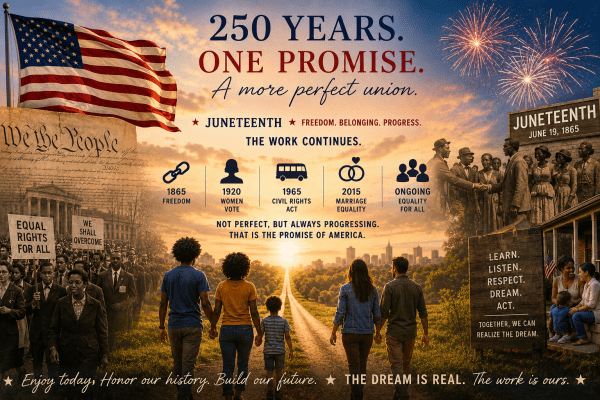
Juneteenth and the Long Road to America’s 250th

I have always loved the Fourth of July.

It carries fewer rigid traditions than Thanksgiving, and none of the frantic end-of-year pressure of Christmas. It arrives in the warmth of summer, inviting us outside—to soak up the sun, fire up the grill, and linger long into the evening. As a kid, it meant fireworks. I still remember a friend who brought back something far more powerful than the parking-lot tent stuff: M-80s, the kind that have been banned under federal law since the 1960s because they’re classified as illegal explosives. We set them off in a drainage tunnel and walked away half deaf for the rest of the day—equal parts reckless and unforgettable.

But beyond the sunshine and questionable judgment, the Fourth of July has always represented something deeper to me: the best of the American idea. A nation founded on a creed that all are created equal, endowed with inalienable rights to life, liberty, and the pursuit of happiness. It is a day worthy of celebration—not because those words were ever fully true, but because they named an aspiration we have been struggling toward ever since.

Juneteenth reminds us of that struggle.

On June 19, 1865, Union troops reached Galveston, Texas, and announced that the roughly 250,000 enslaved people there were free—more than two years after the Emancipation Proclamation had already declared it so. Texas was the last Confederate state to be liberated. It isn’t quite the literal finish line: slavery in the United States wasn’t fully and legally abolished everywhere until the 13th Amendment was ratified that December, nearly six months later, closing the loophole that had let bondage persist a while longer in border states that never seceded. Legal freedom arrived late, in stages, and equality later still.

As the dust of the Civil War settled, the women who helped stitch together a wounded nation had no right to vote. Suffragists labored for another half century before the 19th Amendment finally recognized their voices at the ballot box in 1920.

Then came the deepening shadow of Jim Crow. The “separate but equal” doctrine, handed down by the Supreme Court in Plessy v. Ferguson in 1896, was never equal. It took until the Civil Rights Act of 1964—and the Voting Rights Act the year after—before race could no longer serve as lawful cover for discrimination in employment, public accommodations, and the ballot box.

Even then, freedom remained incomplete. Marriage, under the law, is a civil contract between two people. To deny that contract based on gender is simply another form of exclusion. It took another half century—until the Supreme Court’s 2015 ruling in Obergefell v. Hodges—before that equality was finally recognized nationwide.

And still today, we debate the rights of neighbors whose immigration paperwork is not in proper order—often forgetting that many of our own ancestors arrived on these shores with nothing but hope, faith, and a restless belief that something better was possible.

So I celebrate America’s 250th anniversary, not because our nation is without fault, but because it has shown, again and again, a capacity to confront its failures and move, however imperfectly, toward a more perfect union. Progress has never been automatic. It has always required listening, learning, and the courage to widen the circle of belonging.

I celebrate Juneteenth as well—not as a rejection of our founding ideals, but as a testament to them. Not to erase the words of imperfect people, but to insist that those words matter enough to be lived out fully. History’s greatest danger is not imperfection; it is the refusal to learn.

So I hope you take time to reflect this summer. I hope you enjoy the sunshine, the barbecue, and the fireworks—legal ones, ideally. And I hope you resolve to do the work—quiet or loud, small or bold—required to move us closer to the American dream. That dream still lies down the road, unfinished and demanding, and it will only ever be realized if we choose, together, to keep walking toward it.

Equally supported: An American Manifesto

There is a sinister belief in American politics that the country is “deeply divided”. This is a false reality perpetuated by polarized traditional and social media outlets to improve their advertising profits. They need you to be afraid of the other side so you keep watching, scrolling, clicking and commenting.

The reality is Americans are not deeply divided, we are equally supportive. That’s why we end up with split control of Congress. That’s why one party has not controlled the Presidency for more than 3 terms since Roosevelt. That’s why so many of us are fed up with political extremism.

We equally support limited government, and the need for government spending on infrastructure, education, and social security. We equally support a future of independent clean energy and the need for affordable gas prices today. We equally support the right to own a gun and the right of government to regulate gun ownership. We equally support women’s reproductive health and the fact that each abortion is a personal tragedy. On almost every political issue, you will find the majority of Americans understand both sides of the argument.

We are also fully support the foundations of our democracy, which are rule of law, burden of proof, and free and fair elections.

Most Americans are not deeply divided. They are understanding, reasonable and responsible citizens. This is why our democracy has lasted for over two centuries, and it is why it will continue to thrive.

Some fear-mongers want you to believe that America is threatened, but this only becomes true if the vast majority of political rationalists allow it to happen. We have seen the results of political extremism. It has failed at the ballot box. It has failed at the Capitol Building on January 6th. And it will continue to fail, because we are not deeply divided.

We are united as people who love our families, who want the best for our children, who are willing to work together and who understand that disagreements do not make us enemies, but rather, make us a stronger society. We are united in the rejection of a political arms race toward the extreme right or left. We are united in wanting to find a better way.

It sure as hell makes a better story to make Republicans the enemies of Democrats. But most Republican and Democratic voters are not enemies. We are neighbors, friends, cousins, sisters and brothers. The next time someone tells you the country is divided, I would encourage you to think about if this division is the world you see in your daily life, or is it a manifestation of the screens that are trying to steal your attention.

Reject the narrative that we are deeply divided. Understand that we are instead equally supportive. And that will make all the difference.

E Pluribus Unum

Character, Virtue and Spirituality

Aristotle described virtue as the mean between two extremes, but today, we live in an age where the two extremes are just increasingly mean. We have inflicted retribution upon one another, taking an eye for an eye so many times that most of us walk around blind. The ancient philosophers and mystics warned against the perils we face, but we heed their advice no more than the contemporary masses of their own times. We are a people who have fooled ourselves into believing we can have leadership without character, righteousness without virtue, and peace without spirituality.

We need look no farther than last year’s election to prove the foremost. Perpetual dishonesty, habitual marital infidelity, underhanded business practices and cash exchanges with foreign officials are the antithesis of qualities to be sought in a leader. In describing this list, you cannot determine if I am referring to the candidate who won or lost. In some absurd series of unfortunate circumstances, the electorate decided it best to vote for the lesser evil. But the lesser of evils is still evil, and thus, a conscious decision was made to vote in support of evil. 

The foundation of leadership is the ability to lead oneself. Said otherwise, character is the bedrock upon which leadership is built. When we’re looking for a leader, we should look first for those qualities that make for an upright individual. We should look for character strengths like honesty, humility and perspective. It makes no difference what policies a governor supports if their personal qualities lead the people into a state of corruption and moral filth.

However, I am skeptical to believe that those in power have led to our state of corruption and am more inclined to think we ourselves are to blame. Predominantly, this is a Christian society and the church has long been the standard bearer for morality in America. Today’s Christian community wants to claim the righteousness of Jesus Christ, but chooses to live with the virtues of Mel Gibson. 

Mainline denominations are in discord trying to appease opposing points of view and, meanwhile, relegate preaching the Gospel to a secondary status. The non-denominational and evangelical movement gravitates toward a narrow view that claims to take the Bible literally, but upon examination, takes literally only those parts that are convenient for its culturally homogeneous constituents, and performs theological gymnastics anytime a scripture is opposed to the constituency’s prejudice. 

This has created a moral void in our society. It is unclear how virtue ethics can regain footing in a time where the primary religion is already certain of its own righteousness, while those on the outside see the church for what it has let itself become. 

On the other hand, there is a growing number of us who are religiously unaffiliated. Many of these individuals seek a world peace based on rationality and science. They see those who are vocally religious and rightly identify the hypocrisy of their actions. Paradoxically, these people are equally as intolerant of religion in the same way they claim the religious to be intolerant. Nietzsche is the greatest philosopher who claimed God is dead, but he also went mad from his own internal disharmony. 

There is no peace without spirituality. All of the science, knowledge and rationality obtained throughout human history cannot replace the intrinsic, unspeakable peace that is only found through the introspective realizations brought about by the Spirit. If you acquire all the knowledge of the world, but are out of touch with your soul, you will be unable to achieve the peace that rationality tells you is possible. 

We have a problem. We lack character, virtue and spirituality. We need leadership that reflects these qualities. We need to work harder to cultivate these qualities within ourselves. And yet, I remain optimistic about the human condition. For all the troubles we face, there are those among us who have the answers, and if we quiet ourselves long enough to listen to them, I am confident we will continue to progress as a people. 

At the intersection of character, virtue and spirituality lies an inner peace that cannot be taken from you. If you have taken the time to read this to the end, then I am confident that you are person who values strong character, moral virtues and deep spirituality. If so, then I challenge you to look at your own thoughts and actions, and find the places where you can develop your character, expand your virtues and connect with your spirit. One by one, we can become the change we wish to see. 

Blog at WordPress.com.

Up ↑